Troubleshooting · Pool Pumps · Redding, CA
Pool Pump Not Working? A Symptom-by-Symptom Troubleshooting Guide
A pool pump that isn’t working is almost always one of six things: no power reaching the motor, a failed start capacitor (the pump hums but won’t spin), an air leak on the suction side (it runs but won’t prime or moves little water), a clog in the basket or impeller, failing bearings or a shaft seal (noise or a drip under the motor), or a motor that has finally burned out. This guide walks each one in the order a Redding repair tech would, with the checks you can safely make yourself — as of September 2026.
Redding Pool Pro · Redding, CA · phone line live at launch · Updated September 12, 2026
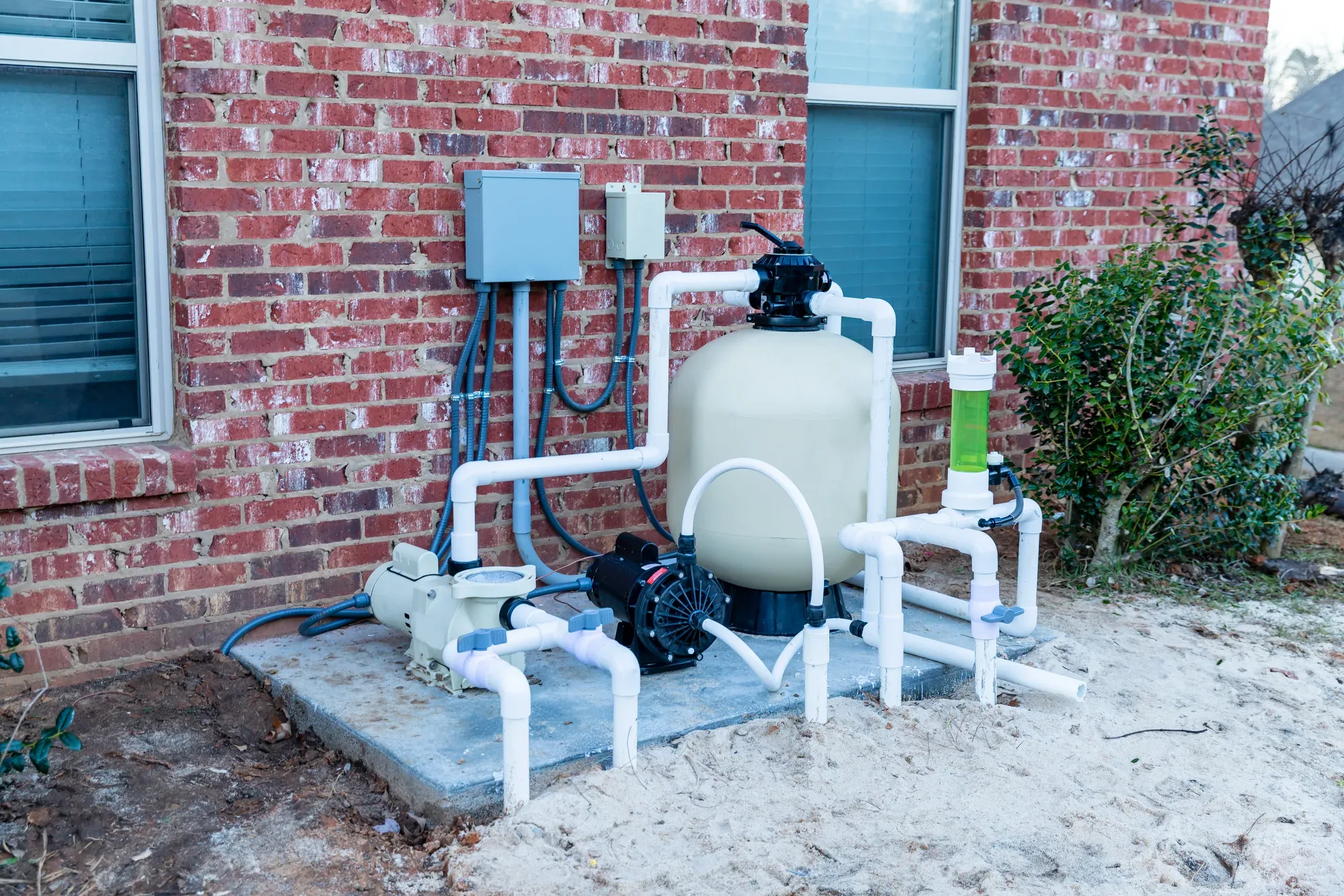
A pool pump has exactly one job — move water — and when it stops, everything downstream stops with it. In a Redding July that's a green pool inside a week. The good news is that a pump has only a handful of ways to fail, and each one announces itself differently: silence, a hum, a tripped breaker, a pot that won't fill, a grind. This guide is organized by that sound (or that silence), goes deeper on each symptom than a repair page needs to, and tells you honestly where the homeowner part ends. What the fixes cost, and the repair-versus-replace decision under California's Title 20, live on the pool pump and motor repair page — this page's job is to get you there knowing what's wrong.
The eight-step troubleshooting sequence
This is the order a repair tech runs through in the first ten minutes on the pad. Do it in order — each step rules something out for the next one.
- Kill power at the breaker, not the timer. Pool pumps run on 115V or 230V and sit next to water. Every hands-on check below is done with the pump’s breaker OFF at the panel — a timer or automation “off” is not off. Confirm by trying to start the pump from the timer after you flip the breaker; nothing should happen.
- Confirm the pump is actually being told to run. Before touching the pump, rule out the schedule. Check the mechanical timer’s trippers or the automation panel’s schedule and any “service mode” setting. Check for a tripped GFCI on the equipment circuit. Check that a variable-speed pump isn’t simply in a low-RPM or paused window. A surprising share of “dead pump” calls are a schedule that got changed.
- Listen at the scheduled start time. With power restored and the pump due to run, stand at the pad. Total silence points to power or the timer. A hum with no spin points to the capacitor or a seized shaft. A normal motor sound with weak or no water movement points to air, a clog, or the impeller. A grind, screech, or rattle points to bearings. Write down which — it decides everything that follows.
- Check the strainer basket, the lid, and the lid O-ring. Power off. Open the pump pot. Empty the basket, look for cracks in it, and inspect the lid O-ring for flat spots, cracks, or grit — a worn lid O-ring — the cheapest part on the pad — is the single most common cause of a pump that runs but won’t prime. Lubricate it with pool-safe silicone lube (never petroleum jelly), refill the pot with water from a hose, and seat the lid evenly.
- Look for water where it shouldn’t be. Still power off. Look at the seam between the wet end (the housing) and the motor. A drip, a rust streak, or mineral crust there is a failed shaft seal. Look under the motor for a puddle and at the motor’s vent slots for signs water has been getting inside. A wet motor is a motor on a countdown.
- Turn the shaft by hand. Power off. On most motors there’s a slot on the shaft end under a rear cap, or you can reach the impeller through the pot with the basket out. It should turn freely with a fingertip. Stiff, gritty, or stuck means seized bearings or a jammed impeller. Free-spinning but the pump only hums when powered means the capacitor.
- Check the impeller for debris. Power off, lid off, basket out. Reach into the pot outlet toward the impeller and feel for leaves, pine needles, pebbles, or a wad of hair. Oak leaves and ponderosa needles that get past a cracked basket are a classic Redding cause of a pump that runs at full speed and moves almost nothing. Clear what you can reach; anything deeper is a housing-off job.
- Read the motor label and stop here if it’s a motor. Note the horsepower, service factor, voltage, and manufacture date on the plate. Multiply HP by service factor for total horsepower. If the checks above point to the motor itself — no hum at all with confirmed power, a burnt smell, a tripped internal thermal overload that keeps re-tripping — stop. Everything from here is licensed work, and a 1.0-THP-or-larger motor has a California-specific replacement rule that changes the quote.
Symptom 1: The pump is completely silent
Silence is a power problem until proven otherwise, and power problems are the cheapest kind. Work from the panel toward the motor. Is the breaker tripped? Reset it once; if it trips again immediately, stop — that's a short, and it's covered under Symptom 3. Is there a GFCI on the circuit, at the panel or in a weatherproof box near the pad, and is it tripped? Is the timer actually calling for the pump — mechanical timers lose their trippers, get knocked out of sync by a power outage, or have a manual override lever that someone bumped to "off." Automation systems have schedules, "service" and "timeout" modes, and firmware quirks; a system that got a power blip during a summer thunderstorm may simply need its schedule re-entered.
If the breaker, GFCI, and timer are all fine and the motor is still dead silent, the fault is in the wiring between the timer and the motor, in the motor's own thermal overload (a self-resetting switch inside the motor that opens when it gets too hot — it can fail open), or in the windings themselves. A burnt-plastic smell at the motor's vent slots, or a motor that was recently running unusually hot, points to windings. That's a motor replacement, and it's where Step 8 of the sequence tells you to stop: the diagnosis is done, the fix is licensed work, and how much it costs — including why a 1-HP-and-up pump in California usually becomes a variable-speed pump rather than a like-for-like motor — is on the pump repair page.
Symptom 2: The pump hums but the shaft doesn't spin
This is the most common pool pump failure there is, and the one most often misquoted. A hum means the windings are energized; a shaft that doesn't turn means the motor never got the starting kick. On a single-speed motor that kick comes from a start capacitor — a cylinder the size of a C battery mounted on the back or top of the motor under a small cover. Capacitors age out, swell, leak, and fail, especially after a hot season on a pad in direct sun. When one dies, the motor hums, may get hot, and often trips its thermal overload after thirty seconds or so, goes quiet, cools, and tries again. Some pumps can be "helped" to start by spinning the shaft by hand — that's the classic capacitor confirmation, and it's also the reason people run a bad capacitor for weeks and eventually take the windings with it.
The other two causes of hum-no-spin are mechanical. Seized bearings: turn the shaft with the breaker off; if it's stiff or won't move, the bearings have failed, and you'd usually have heard them screaming for a while first (Symptom 5). A jammed impeller: a pebble, a hairball, a chunk of a broken basket wedged between the impeller vanes and the diffuser. Reach in through the pot with the basket out and feel for it. If the shaft turns freely by hand but the motor only hums when powered, it's the capacitor, full stop — a repair at the very bottom of the $50–$300 band, and a fix a homeowner should not be quoted a full motor for.
Variable-speed pumps don't use a start capacitor — their drive electronics start the motor — so a VS pump that "hums" or clicks and doesn't spin is usually reporting a fault code on its display. Note the code; it's the first thing the tech will ask.
Symptom 3: The pump trips the breaker
A tripping breaker is the motor drawing more current than the circuit allows, and the timing of the trip tells you why. Trips instantly on start: a dead short — a shorted winding, water inside the motor from a failed shaft seal, or a wiring fault at the motor's terminal board. Reset it once to confirm; don't keep resetting it. This is almost always a motor replacement. Trips after running a while: the motor is overheating and its current climbs as it does. Causes, roughly in order of likelihood: bearings on their way out, vent slots packed with grass clippings or spiderwebs, a motor with no shade running at full speed through a 98°F afternoon, a pump that's been running dry (lost prime) and cooked itself, or a capacitor that's weak but not dead. The bearing case is worth catching — a motor that trips after twenty minutes and grinds is often still repairable if the seal and windings are intact.
Two non-pump causes worth ruling out: an old breaker whose trip point has drifted (breakers do wear), and a second load that got added to the pool circuit — a heater's blower, a salt cell, a pool light transformer — pushing the total over the limit. If a licensed electrician added anything to that circuit recently, start there.
Symptom 4: The pump runs but won't prime, or moves little water
Here the motor is fine and the problem is air or a restriction. A pool pump is not a self-lifting vacuum; it needs the pot full of water and an airtight suction side to pull water up from the skimmer and main drain. Any air leak on the suction side gets sucked into the pot, the pump churns air, and flow drops to a trickle or stops. The usual culprits, from most to least common on a Redding backyard pool:
- Water level too low. Below the middle of the skimmer opening, the skimmer gulps air. In August, with evaporation at a quarter to half an inch a day, a pool with no auto-fill can drop below that line in a week of not looking. Top it up, refill the pot, restart.
- The pump lid O-ring. Flat, cracked, dry, or sitting on a grain of sand. Clean the groove, inspect the ring, lube it with silicone, and seat the lid evenly. If the lid is cracked, replace the lid.
- A cracked pump pot or a loose drain plug. Hairline cracks in the pot (often from a hard freeze on a pump that wasn't drained, or from over-tightening the lid) suck air under vacuum and only weep water when the pump is off. Look for a wet spot at the base of the pot after shutdown.
- Suction-side unions and valve stems. The union between the plumbing and the pump, and the stems of any 3-way valves before the pump, both have O-rings. Sun and age harden them. A leak here is invisible while running and shows as a drip when the pump stops.
- Skimmer weir stuck closed or a skimmer basket packed with leaves. Redding oaks and pines produce a lot of both. Clear the basket, check the weir flap swings freely.
- An underground suction-line leak. The one you can't fix from the pad. If everything above checks out and the pump still pulls air, a pressure test of the suction line is the next step — the pool leak detection page covers what that costs and who does it.
A running pump with low flow and a high filter pressure reading isn't a pump problem at all — the filter is the restriction. Clean it, or if pressure won't come down, see the heater and filter repair page. Low flow with low pressure means the restriction is upstream of the pump: baskets, the impeller, a valve someone turned, or the air leaks above.
Symptom 5: Grinding, screeching, or rattling
Bearings. Pool motors have two sealed ball bearings, and they fail from age, from heat, and — most often — from water that got past a failed shaft seal and washed the grease out. The sound starts as a whine at startup, becomes a steady grind, and ends as a scream. Every week you run a screaming motor, the heat and vibration work on the windings and the seal; a bearing job caught early ($65–$300) turns into a motor replacement ($250–$650) if it's ignored through a summer. A rattle that comes and goes is more often something loose — a mounting bolt, a cracked motor cooling fan, or debris in the impeller — than a bearing.
One honest caveat about bearing repair: on an older motor, replacing bearings means pulling the motor apart, and many repair companies will tell you the labor is close enough to a motor swap that the swap is the better value. That's often true. It's a fair conversation to have, as long as it's a conversation and not a surprise on the invoice.
Symptom 6: Water is dripping from the pump
Where the drip comes from is the diagnosis. From the seam between the housing and the motor, or from a small weep hole under that seam: the shaft seal — the spring-loaded ceramic-and-carbon seal that keeps pool water out of the motor while the shaft spins through it. Seals fail from age, from running the pump dry (they need water to stay cool), and from chemistry: a pool that ran acidic or that got a big dose of shock through the skimmer eats seals. Caught early it's a seal. Left for a season, the water reaches the bearings, then the windings, and the $50–$300 repair becomes a motor. From the lid: the O-ring or a cracked lid. From the base of the pot when the pump is off: a cracked pot or a loose drain plug — and an air leak when it's on. From a union: its O-ring, or a union that's cross-threaded. Only the lid and union O-rings are homeowner fixes; a seal is licensed repair work.
Symptom 7: The pump runs constantly, or won't shut off
Not a pump failure, but people search for it as one. A mechanical timer with a stuck or missing "off" tripper, an automation schedule set to 24 hours, a freeze-protection mode that's kicked in (many controllers run the pump whenever the air temperature drops near freezing — normal on a December night in Redding, alarming if you don't know it's there), or a relay that's welded closed. Check the schedule and the freeze-protect setting first; a relay is an electrical fix. Our winter pool service guide explains freeze-protect behavior.
Symptom 8: A variable-speed pump shows an error
Variable-speed pumps put a computer between the power and the motor, and they report through it. Common displays: a low-voltage or over-voltage error (check the supply and the breaker), an over-temperature error (the drive's heat sink is clogged or the pump is in afternoon sun with no airflow — very common on Redding pads), a "no flow" or prime-failure error (Symptom 4, the pump is doing your diagnosis for you), a communication error with an automation system (a cable or address setting), or a drive fault, which is the one that usually means the drive board and is a parts question for the manufacturer. Write the code down exactly as shown. The manufacturer's manual, not a generic list, is the right decoder.
Where the homeowner part ends
Everything above the motor's terminal board — baskets, O-rings, water level, timer schedules, clearing an impeller you can reach — is yours to do. Everything that opens the motor or the housing — capacitor, seal, bearings, impeller replacement, the motor itself — is contractor work in California under the CSLB's D-35 Pool and Spa Maintenance classification once the job passes the state's minor-work threshold, which most of these do by the time parts and labor are added up, and all of it involves line voltage on a wet pad. There's also the California-specific fork that every national troubleshooting guide misses: if the motor is done and the pump is 1.0 total horsepower or more, the replacement is not a like-for-like single-speed pump. The Title 20 rule, the repair-versus-replace decision tree, and what each outcome costs in Redding are all on the pool pump and motor repair page.
What to tell the repair company
The difference between a two-hour visit and a full afternoon is the information you bring. Have ready: the symptom in one line ("hums, shaft turns freely by hand," "trips the breaker after twenty minutes," "runs, pot won't fill, drip at the pot base when off"); the motor label — horsepower, service factor, voltage, date; the pump make and model; whether it's single-speed or variable-speed and any code on the display; and what you already checked. A company that hears "capacitor" from you is much less likely to quote a motor.
Common Questions
Why does my pool pump hum but not turn on?
Nine times out of ten it’s the start capacitor — a small cylinder on or in the motor that gives it the kick to begin spinning. When it fails, the windings energize (the hum) but the shaft never gets moving. The other causes are a seized shaft from failed bearings or an impeller jammed with debris. Turn the shaft by hand with the breaker off: free means capacitor, stuck means bearings or a jam. A capacitor is at the bottom of the $50–$300 repair band.
Why does my pool pump keep tripping the breaker?
A motor drawing more current than it should. If it trips the instant it starts, suspect a shorted winding or water inside the motor (check for a failed shaft seal) — usually a motor replacement. If it runs for a while and then trips, the motor is overheating: failing bearings, blocked vent slots, a pump running dry, or a motor in direct afternoon sun without airflow. If the breaker itself is old, it can also be the breaker.
Why won’t my pool pump prime?
Air is getting in on the suction side, or the water level is too low. In order: water level below the skimmer’s midpoint; a cracked or unseated pump lid O-ring; a cracked pump pot; a loose suction-side union or a valve stem that leaks air; a skimmer weir stuck closed; a clogged skimmer or pump basket. Fill the pot with a hose before restarting — a pump that starts dry can lose prime again before it pulls water up the line.
Pool pump runs but no water is coming out — what’s wrong?
The motor is fine; something is blocking or bypassing flow. Check the pump basket and skimmer basket, the lid O-ring, the impeller for debris, and any valves that got turned. Then look at the filter pressure gauge: if it’s high, the filter is the restriction, not the pump. If pressure is very low with a running pump, the restriction is before the pump (suction side).
Can I fix my pool pump myself?
Cleaning the basket, replacing the lid O-ring, clearing an impeller you can reach, and adjusting the timer are homeowner tasks. Replacing a capacitor, shaft seal, bearings, or the motor — anything that opens the motor or the housing — is D-35-licensed contractor work in California once parts and labor add up, and it involves line voltage next to water. That’s where this guide hands off.
Does Redding Pool Pro repair pumps?
No. Redding Pool Pro is an independent referral service — we connect you with independent, local companies that hold a CSLB D-35 (or C-53) license for pool equipment repair. Use the form on this page with the symptom you found, and one of them will call you.
Get Matched With a Local Pool Pro
Tell us what's going on and your city — we'll connect you with an independent pool cleaning or repair company that covers it.